Friday, March 31, 2006

Wade Burleson's Dream for the Future of the SBC

One of the most encouraging things I have read in recent days is Wade Burleson's post I Have a Dream for the SBC. If you have not read this, I strongly encourage you to do so. Wade lays out a vision that, if realized, would free us from many of the petty squabbles that consume much of our time and effort and would allow us to focus more on our Kingdom mission. Here are some excerpts from his post (be sure to go to his blog and read the post in its entirety):

My dream for the Southern Baptist Convention is a threefold vision or desire:

1. Liberty for the People within the SBC. . .

I have a dream where we have a convention that is characterized by liberty; liberty of conscience, liberty of dissent, liberty of the soul.

The privilege of dissent is especially vital for the health of our convention. It is possible for the majority to make decisions that are not healthy for the convention in the long run, but through patient, loving dissent, there is the very real possibility that unhealthy decisions may be reversed. . .

It is liberty of dissent that sharpens us. It is the liberty of dissent that strengthens us. I have a dream that we have a convention that is not fearful of dissent, but embraces it as part of our heritage, welcomes it as a vital member of our Baptist family, and sees it as a blessing and benefit in the longrun. . .

Yes, we need our confessions. However, let's be slow to tamper with our confessions. And we must absolutely not allow anyone to narrow the parameters of fellowship and cooperation beyond our confessions. And let's hold sacred the principles of liberty so that we do not become a creedal people, a denominational sect, and in the end, a people more concerned about jots and tittles than God and people.

2. Love for the World outside the SBC.

The Kingdom of God is bigger than the Southern Baptist Convention. God's kingdom includes all the elect from every nation, tribe, kindred and tongue, and it transcends any one denominational boundary.

I have a dream that Southern Baptists see the hand of God at work in other evangelical venues, and where possible, join in the efforts of those of like faith to win the world for Christ. In many cases we will be the forerunners of the gospel, reaching into nations, peoples and lands where the gospel has little presence. Where we lead the charge, I pray that we will welcome the support of other evangelical witnesses who follow. The world is too big, the time is to short, and the lost are too many to believe that we Southern Baptists can do it alone. . .

When we as Southern Baptists are more concerned for the lost than we are that we get the credit for the new church plants, then we will truly be Kingdom minded. When we are more concerned for the lost than we are that we separate from any other evangelical who is not called a Southern Batpist, then we will be truly Kingdom minded. God has called all his disciples to be Great Commission disciples and to the extent that we participate with other Great Commission discipoles all over this world to fulfill our Lord's command is the extent to which we will be fulfilling that Commission given to us.

3. Loyalty from the churches in the SBC.

I have a dream that every Southern Baptist Church will be loyal and faithful to contribute to the Cooperative Program, and all our agency offerings, particularly the Lottie Moon offering.

I am of the opinion, however, that to demand loyalty without allowing freedom to dissent or exhibiting a love for others outside the SBC will be like putting the cart before the horse.

Loyalty to the SBC from the younger generation must be earned. It doesn't happen automatically.

What do you think of Wade's vision? Is this vision one that you would support? Do you believe that it will ever come to fruition? Do you think that things would be different if this vision were to become reality?

Thursday, March 23, 2006

How About Some Good News?

Despite some cautious optimism, most of the reaction to the recent IMB trustee meeting in Tampa has been that of anger or discouragement. So it seems that now is the perfect time for some good news to encourage us. The following posts discuss some positive things that have been happening:

Guy Muse, You Pray. . . and God Answers!
Kiki Cherry, 10 Things I Learned in Quebec
Kevin Hash, University Students Use Spring Break to Rebuild in Pass Christian, Mississippi
Jason Sampler, Update from New Orleans
Marty Duren, Missional Church

What good things have been happening in your life? In what ways have you seen God working recently? Share your good news and let us rejoice together!

Wednesday, March 22, 2006

Outrageous! (Updated)

The Board of Trustees of the International Mission Board of the Southern Baptist convention has wrapped up its meeting in Tampa. Thank God! There's no telling what other outrageous actions the board would have taken if the meeting had not adjourned. The best firsthand summaries of what happened can be found on the following blogs:

SBC Outpost (Marty Duren)
Big Brother--Tampa, Part 1
Smoke and Mirrors--Tampa, Part 2
Merry Go Round--Tampa, Part 3
This Is Dedicated to the Ones I Love--Tampa, Part 4

Grace and Truth to You (Wade Burleson)
Wise Heads and Warm Hearts
My Last Post as an International Mission Board Trustee?
Decisions
Ten Terrific Things Tied to Tampa

The Road We Travel (Rick Thompson)
Reflections on Our IMB Meeting (Everyone Stay Calm)
Resolutions I Am Making Coming Out of Our Last IMB Meeting

I cannot understand how anyone can read about what transpired at the IMB Board meeting and not be outraged. The board has declared that once they have made a decision that no trustee can express public disagreement with that decision. Apparently the board wants to make sure that all of us ignorant Southern Baptists are never again tipped off about some bonehead decision made by the board so that we will never again have the audacity to dare express our opposition to such a decision. It would not surprise me if the board's next move would be to attempt to move all matters of substantive business to executive session so that independent observers (whom the board cannot silence) would have nothing to report on. That way the board could exercise absolute control over all information about its proceedings, which seems to be the direction it wants to move toward.

I can't figure out for certain whether the primary force behind this new policy is arrogance or ignorance. Arrogance in the sense that the trustees are saying, "This is our board! We don't have to answer to anyone except ourselves!" Ignorance in the sense that the board seems not to realize that this action will erode what's left of any trust that a number of Southern Baptists, especially us younger ones (but many others as well), might have had in the board. It appears that the majority of trustees can't get it through their heads that this push to enforce conformity is one factor that is causing a number of younger people to reevaluate whether or not the SBC is the place for us. We value transparency, openness, and the free exchange of ideas. We understand that there is a difference between uniformity and unity. We are more interested in right being done than in procedure being followed. We are willing to fellowship with and cooperate with others with whom we disagree on certain issues. And we don't see the recent actions of the board as reflective of these values.

After reading about this new policy, my first instinct was to advise Wade and other likeminded trustees to resign as a matter of principle. But upon further reflection, and after reading a comment from one of our missionaries asking who would be their voice, I concluded that these trustees need to remain on the board so that someone on the board can be a voice for our missionaries. Sadly, it seems that too many of our trustees really don't care what our missionaries think about policies and strategy; at least that is the perception of many current and former missionaries, and it seems to be a valid perception. Even more disturbing is the fact that there is such an atmosphere in the IMB that many missionaries feel that they cannot openly share their views without suffering some sort of reprisal. Why doesn't the Board of Trustees work on creating an environment where our missionaries feel free to speak out on issues that directly affect them instead of imposing policies to shut the mouths of those trustees who would speak out about many of the concerns our missionaries have?

Another appalling aspect about this meeting was the way that some of the trustees attacked IMB President Jerry Rankin. One trustee engaged in a petty squabble because Rankin had not given him a copy of a video that he asked for, even though Rankin showed the video to the entire board. Others accused Rankin of trying to undermine the authority of the trustees. (Hmmm, what about trying to undermine the authority of the president?) And at least one trustee basically accused Rankin of lying. Such actions only confirm suspicions that some of the trustees are seeking after power and control.

In spite of all of this, Wade and Rick both gave a generally positive assessment of the meeting. Of course, the new policy does not allow for any other type of assessment. But still, their positive remarks are genuine; had they not truly believed that some good things happened, they would have remained silent. Both of them pointed to the unanimous vote to rescind the motion to remove Wade and the adoption of a new policy that prohibits trustees from publicly disparaging other trustees or IMB staff. Rick talked about the overall positive demeanor of the meeting as a good sign. Wade had quite a bit to say about the increased interest in the work of the IMB and its board as evidenced by the attendance of about 20 young SBCers and the volume of correspondence the board has received in the past few months. Both are optimistic about how this situation will ultimately turn out. I wish I could share that optimism, but at this moment I simply cannot be optimistic. It is hard to be optimistic about the IMB when any trust I had in its board has been wiped away by that board's actions. I can only hope that their position as insiders gives them some real cause for optimism that we on the outside cannot see.

UPDATE! Marty has also indicated that some good things happened at the meeting but has not had the opportunity to discuss this in detail. He was very complimentary of Tom Hatley's leadership of the meeting. Hopefully he will say something that will generate a little optimism. I would love for someone to prove me wrong (and I don't say that very often).

Tuesday, March 14, 2006

A Reassessment of Jerry Corbaley's Blog

You are probably aware that a couple of weeks ago IMB trustee Jerry Corbaley started his own blog. After reading his first two posts, I expressed my disappointment with Corbaley's blog, particularly the attitude that he seemed to convey in his posts and comments. Today I visited Corbaley's blog for the first time in a few days, and I was impressed by the change in the tone of his statements. His most recent remarks seem to demonstrate a spirit of genuine humility, a willingness to listen, and an awareness that there must be greater transparency and more open communication. There is also more of an emphasis on trying to find solutions than on defending the way things have been done. Corbaley acknowledged that blogging is a permanent part of SBC life and that our SBC entities are going to have to figure out a way to interact with the blogosphere. The main area where Corbaley's blog still disappoints is his failure to discuss why he supports the IMB policies. But other than that, he has taken a number of positive steps with his blog over the past several days and is now making some productive contributions to the overall discussion.

Let's Not Get Personal

Over the past few days there has been a noticeable shift in the discussion of the issues surrounding the recent actions of the IMB Board of Trustees. While there have always been some issues at the center of the discussion regarding certain individuals (this is inevitable when you have an effort to remove an individual from a position), for the most part the discussion has remained focused on the policies and the reasoning behind the policies. Such a discussion is necessary and healthy, but if we allow the discussion to degenerate into a series of insinuations and accusations against other people then it will become counterproductive and even destructive.

Let me make it clear that I see a difference between using blunt or polemical language to refute someone's arguments and making statements that malign someone's character or cast aspersions upon their motives. I call attention to this distinction because I have been vocal in my support of Benjamin Cole's critical remarks about the rationale offered for the IMB policies, which some have said were inappropriate and even un-Christian. After reading Cole's remarks again, the only thing I believe he should have done differently was to refer to the position papers in a generic manner instead of continually referring to them as Tom Hatley's statement. For example, instead of saying, "Chairman Hatley’s logic goes something like this," Cole probably should have said, "The paper's logic goes something like this." That way, people would have been less likely to identify Cole's attack on the position as an attack on Hatley himself. I do not see Cole's remarks as being an attack against Hatley's character or motives; if Cole is attacking anything about Hatley, it is Hatley's logic and use of Scripture.

While I don't consider Cole's remarks to be any sort of personal attack, on various blogs I have read some recent comments that subtly, and sometimes openly, cast aspersions on various individuals' motives and character. Such comments have been made by and about people on both sides of the issues. I have chosen not to give any examples of or links to these comments, but if you have read enough blogs you have probably seen these comments already.

I strongly encourage everyone engaged in this discussion, on all sides, to strive to avoid making statements that question or attack anyone's character or motives. You can offer support for your own views and point out weaknesses in other views without questioning the character or motives of those who disagree with you. Let's try to keep the discussion focused on the issues rather than on individuals.

Friday, March 10, 2006

An Important Letter in Response to the IMB Policies and Position Papers

If you have been reading the various SBC blogs for any length of time, you have probably read comments by Dorcas Hawker. On her blog she has posted a letter from her pastor to their congregation that completely demolishes the position papers released by IMB trustee chairman Tom Hatley earlier this week. This letter is a MUST READ.

WARNING! This letter is not for the faint of heart. Brother Cole is blunt and direct in his treatment of the policies, the position papers, and even some of the trustees. Some commenters felt that this letter went over the line, but others believe that the situation calls for such a response. My opinion can be inferred from the following comment I made after reading the letter:

I wonder if those who are critical of the tone of this letter are critical of John the Baptist, Jesus, and Paul for some of the language they used. Could Brother Cole have toned down his remarks? Perhaps, but if his reaction to the position papers was similar to my reaction, then this letter is a toned down response. The fact is, there are occasions when it is necessary for Christians to use blunt and even harsh language (again, refer to John the Baptist, Jesus, and Paul). Such cases are the exception to the norm, but I believe the gravity of this current issue meets the standard.

This is by far the most effective refutation of the position papers I have come across (much better than my statement). It needs to be read by as many people as possible, so I am linking to this post from my blog.
(HT: Marty Duren)

Wednesday, March 08, 2006

An Examination of the Position Papers Concerning the IMB Policies on Baptism and Tongues/Prayer Language

As promised, I am now going to offer my analysis of the position papers that were released yesterday to support the new IMB policies on baptism and tongues/prayer language. As a disclaimer, I remind you that I have been strongly opposed to both of these policies since they were adopted in November, but I have always expressed a willingness to change my position should I be provided convincing biblical evidence for the policies. Having read the position papers, I find that both policies rest on weak biblical foundations. Thus, my opposition to the policies remains as strong as ever.

In examining these position papers, I will not go through them point by point. (If I did that then I would be here all day and probably longer.) Instead, I will focus on broad areas where I disagree (and in some cases even agree). I also will not deal very much with the historical justifications given. While I acknowledge the importance of heritage and historical background (I do have a master's degree in history and spent three years working on a Ph.D. in history), I believe that in matters of faith and practice that we must look to the Bible rather than tradition or history. If you are really interested in an analysis of the historical arguments, you should read what Gene Bridges has to say here and here at SBC Outpost.


An Examination of the Position Paper on the Baptism Policy

Before reading any further, make sure you have read the official baptism policy and the position paper itself.

According to the position paper, the baptism policy is based on four points:

  1. "The only biblical mode for baptism is immersion." I agree completely, as does practically every other Southern Baptist. This particular issue is not a point of contention in this discussion, but it seems that some of the supporters of the policies believe that opponents are in favor of accepting various modes of baptism (sprinkling, pouring). Let me be perfectly clear that I, and everyone I know of who opposes the policy, believe that immersion is the ONLY biblically acceptable mode for baptism.
  2. "The only proper candidate for immersion is a regenerate believer in Jesus Christ." Again, there is no disagreement here. Everyone that I know of who opposes the policy is a credobaptist.
  3. "The act is purely symbolic and distinct from salvation itself and has no saving merit." And yet again, we agree completely. None of the opponents of the policy have, to my knowledge, expressed a belief in baptismal regeneration or that baptism is sacramental. In fact, some of the arguments used to support the policy lean toward a sacramental view of baptism.
  4. "Baptism is a church ordinance and therefore the only proper administrator of it is a local New Testament church that holds to a proper view of salvation." Here's where we have some disagreement. Among opponents of the policy there is general, but not universal, agreement with the first part of this statement, but it is the second part where we find the greatest problems. The rest of my analysis will focus on this last statement.
In arriving at an understanding of what baptism is, we have to start with what the Bible says about the subject. Since nearly all of us are in agreement on points 1-3 above, I won't discuss the biblical support for these points. So what does the Bible have to say about point 4? Apparently not much, because in the position paper there is no reference to any passage of Scripture that clearly supports either one of the assertions made in point 4 (whereas there are quite a few citations of Scripture to support each of the first three points). Instead, there are references to each of the three versions of the Baptist Faith & Message, and several passages of Scripture that support the doctrine of eternal security (which is believed by all of the opponents of the baptism policy that I know of) .

The position paper refers to the baptism of Jesus and the account of Paul in Ephesus in Acts 19 in an effort to provide some sort of justification for the policy. But when you read the biblical accounts of the baptism of Jesus, where do you see anything that indicates that the reason Jesus went to John to be baptized was because John had "proper baptismal authority?" The writers of the paper must be using a translation that I'm not familiar with. And the paper's use of Acts 19 is an example of either selectively using Scripture to prove a preconceived point or poor interpretation. The paper implies that the first thing Paul did when he arrived was to ask unto what they had been baptized, but actually Paul's first question was, "Did you receive the Holy Spirit when you believed?" It was only when they said they had never even heard of the Holy Spirit that Paul asked about their baptism. He didn't ask this question to determine what doctrines they had been baptized into, but to find out if they had been baptized into the name of the Lord Jesus.

The new baptism policy reflects an unbiblical view of baptism. When the Bible speaks of believers being baptized, it either says that they simply were baptized or that they were baptized into the name of Jesus (Acts 8:16; 10:48; 19:5). In other words, their baptism is a symbol of their uniting with Christ Himself. Nowhere in the Bible do we see believers being baptized into a local church, nor do we see believers being baptized into a particular set of doctrines. Thus, being baptized in a church that affirms eternal security does not mean you have been baptized into the doctrine of eternal security, nor does being baptized in a church that does not affirm eternal security mean that you have been baptized into the doctrine of falling from grace. If this were the case, then a person baptized in an Arminian Southern Baptist church should be rebaptized upon joining a Calvinistic Southern Baptist church because the two churches have different theologies of salvation. And why limit it to eternal security? Why not require rebaptism for a person baptized in a church that affirms women as pastors? Why not require rebaptism for a person baptized in a church with a different view of inerrancy? Indeed, just to be safe, every church should require rebaptism of everyone who joins, because there will be some point of doctrine where there is a difference between the receiving church and the baptizing church. What the proponents of the policy fail to mention is that there is not one single example in the New Testament of a person who had received Christian baptism ever being rebaptized. (The people in Acts 19 had originally received John's baptism and not Christian baptism.)

And what about the concept that baptism requires a qualified administrator to be valid? Again, there is no direct biblical statement to support such a concept. In fact, the only statement I can find that even remotely touches on the subject is the Great Commission (Matthew 28:18-20). In the Great Commission Jesus commands His disciples to "go and make disciples of all nations, baptizing them in the name of the Father and of the Son and of the Holy Spirit, and teaching them to obey everything I have commanded you." Here we clearly have Jesus commanding His disciples to evangelize, baptize, and disciple people of every nation. So what we see in the plainest reading of the text is that all disciples of Jesus are authorized to evangelize, baptize, and disciple others. Now some claim that the Great Commission was given not to all believers but only to the eleven remaining apostles, and thus only duly ordained and authorized ministers can baptize. If this is the case, then logic would dictate that not only baptism but evangelism and discipleship could only be carried out by duly ordained and authorized ministers. There is no basis for treating baptism differently from the other parts of the Great Commission. Also, notice that in the Great Commission Jesus says nothing about the local church or its authority.

Obviously I have not addressed all the relevant issues related to the baptism policy. What I have attempted to do here is to demonstrate that the new baptism policy does not have any solid biblical support. If you are interested in a more detailed discussion of baptism and the IMB policy, you can read the comments on my earlier post Wade Burleson on "Who Can Baptize?" This is a lengthy, spirited discussion where both sides are expressed.


An Examination of the Position Paper on the Tongues/Prayer Language Policy

Before reading any further, make sure you have read the official tongues/prayer language policy and the position paper itself. Also, let me preface my remarks by stating that I have never spoken in tongues or practiced a private prayer language, I have never desired to do either one, and I have never witnessed either one. A lady in a previous church, one of the most spiritual and godly people I have ever met, did practice a prayer language, and a teacher I had in high school told about a time he witnessed someone speaking in tongues (it was done in a controlled and orderly manner, and someone interpreted).

This position paper has a stronger scriptural basis than the paper on the baptism policy. It does a good job of describing the biblical guidelines for the use of tongues in public worship (primarily found in 1 Corinthians 14). The only significant area where I may disagree with the paper is in its insistence that every single use of glossa definitely refers to a known human language. It is possible that the same word used to describe earthly languages could be used to describe a heavenly language. One could argue that the context of 1 Corinthians 14:2, "For anyone who speaks in a tongue does not speak to men but to God," indicates something different than what took place in Acts 2, where the disciples were definitely speaking to other people. I'm not convinced that we can make a dogmatic claim either way, which is one reason why I am uncomfortable drawing lines on the basis of this issue.

It is evident that in most cases the use of tongues in public worship in American churches today does not strictly adhere to the principles of 1 Corinthians 14. However, the fact that a practice is misused or abused does not mean that the practice itself is invalid. In light of Paul's statement in 1 Corinthians 14:39, "Do not forbid speaking in tongues," I have a difficult time accepting any policy that is a blanket prohibition of the use of tongues in a manner consistent with the biblical guidelines.

What the paper does not demonstrate is that the use of a private prayer language is unbiblical. Paul's statements in 1 Corinthians 14 seem to apply only to public worship. Indeed, when verse 28 says that a person should not speak in a tongue out loud in the church if there is no interpreter present but should speak to himself and to God, it is possible to infer that in private there would be no reason for this person not to speak out loud. Again, we cannot say this is definitely the case, but it would be a reasonable inference. What is clear is that in the Bible there is not a blanket prohibition of using a prayer language in private, nor is there a clear endorsement of the practice. Thus, since there is no definitive scriptural teaching either way we should leave this matter to the individual believer.


In my examination of these position papers I have not tried to prove their interpretations wrong so much as to simply demonstrate that there are other plausible interpretations that have biblical support. I have no problem with drawing doctrinal lines on essential issues where the Bible speaks clearly and definitively. But on issues such as the ones addressed by the policies, which either are nonessentials or are not addressed by the Bible in an absolutely clear and definitive way, we should not draw these lines. Also, keep in mind that both of these policies go well beyond the doctrinal parameters of the Baptist Faith & Message, which is the statement that we as Southern Baptists have adopted as a definition of our core doctrinal beliefs.

Tuesday, March 07, 2006

It's About Time

It took nearly four months, but today IMB Trustee Chairman Tom Hatley finally released several statements intended to justify the IMB policies/guidelines regarding private prayer language and baptism that were adopted in November. (For the sake of simplicity, I am going to refer to both of them as policies, even though there is a technical difference between a policy and a guideline.) Not all of these statements have been officially adopted by the IMB Board of Trustees, but they do explain some of the reasoning behind the adoption of these policies. After reading the statements released by Hatley, I can see why the trustees were in no hurry to make any public statements justifying the new policies. An examination of these various statements reveals that, while there may be some historical basis for the new policies, they lack a strong biblical foundation to support them. Also, these policies will ultimately do more to harm our missions efforts than help them.

As a preface to his statements, Hatley issued a two-part open letter, the first part to all Southern Baptists and the second part specifically to Southern Baptist pastors. In this letter he briefly describes the appointment process for missionaries and then goes on to explain why the trustees felt there was a need to address the issues of tongues/prayer language and baptism. Basically, there were two main reasons why the trustees addressed these issues:

  1. There was a lack of uniformity among the subcommittees of the board when they evaluated missionary candidates, particularly in the areas of tongues and baptism. This inconsistency made the work of candidate consultants more difficult.
  2. "At the same time we were receiving concerns from the field, from pastors and others returning from mission trips, and from trustees visiting the field. The concerns were varied, but the three greatest doctrinal concerns were the need for a consistent definition of a local church, a poor understanding of the importance of scriptural baptism and charismatic problems that would intrude into some of our mission work."
There is no doubt that such concerns needed to be dealt with. However, the first concern could have been dealt with fairly easily by developing a uniform means of applying the policies in existence at the time. Instead of imposing overly restrictive new policies, just train the trustees and candidate consultants so they could apply the existing policies in a more uniform manner. The second concern should have been addressed by discussing these issues directly with the missionaries. (This may have been done in some cases, but I am not aware of any trustee or missionary who has said that this was done.) Based on several comments by former and current missionaries, many of these concerns probably stemmed from the fact that churches in other cultures are going to differ from the typical Southern Baptist church here in America in a number of ways, especially related to organization and methodology. But even if these concerns are valid, they cannot be addressed by adopting policies that go beyond the clear teaching of Scripture.

In his open letter Hatley also addresses the speculation that one of the reasons that these policies, especially the one on prayer language, were adopted was somehow to embarrass or injure IMB President Jerry Rankin, who has openly acknowledged practicing a private prayer language. Hatley indicates that it was Rankin himself who requested the board as a whole to address these issues. Hatley is technically correct about this, but his letter does not make it clear that Rankin actively opposed these policies. From what I can tell, Rankin requested that the full board consider these issues so that there could be no mistaking what the official policies were. And as a matter of pure speculation on my part, I believe Rankin thought that the entire board would never vote to adopt such bad policies.

For the sake of brevity, I will reserve my examination of the policies and the position papers that were issued in support of them for a subsequent post. In the meantime, let your voice be heard. Hatley has invited all Southern Baptists to give our feedback on these issues by emailing the trustees at imbtrustees@imb.org. Be sure to express your views there, but also keep contacting individual trustees.

Friday, March 03, 2006

A Disappointment. . . So Far

After several weeks of almost total silence from the IMB trustees who voted for the new policies on prayer language and baptism and for the recommendation to remove Wade Burleson as a trustee, one trustee has finally spoken up. Jerry Corbaley, a trustee from California who supports both the new policies and the removal of Wade, started his own blog this week. When I visited his blog I eagerly anticipated seeing someone finally provide some reasons in support of the IMB actions, but so far Corbaley's blog has been a disappointment. Instead of saying anything that might support the IMB actions, Corbaley has tried to justify the silence of the trustees on these issues. While this is disappointing enough for those of us who believe that an explanation is warranted, the greater disappointment comes from the attitude conveyed by Corbaley in some of his remarks. I'll provide some brief excerpts, but to get the full flavor you need to read Corbaley's posts and the comments in their entirety.

I posted this comment on Corbaley's first post:

Jerry,

I appreciate seeing another one of our IMB trustees posting their own blog. The best way for our trustees to demonstrate their accountability to the SBC is for you to communicate with the people of the SBC regarding your actions (with the obvious exception of matters that must remain confidential for security or legal reasons). I think it would be great if every trustee of every SBC entity had his or her own blog. Then we would have a greater understanding of the issues facing the SBC.

While I have been strongly opposed to both the new policies and the recommendation to remove Wade, I have repeatedly called on those on the other side of these issues to explain their case. I look forward to your subsequent posts.
Apparently, Corbaley did not care for my suggestion that all trustees start their own blogs. But I'm not certain because, to be honest, his response did not make a whole lot of sense to me:
Tim,

Every trustee of every institution having their own blog? Every Southern Baptist expressing a different opinion on everything?

Have you run this idea by Stephen King? You could terrify movie-goers everywhere and make a bundle.

You may be right about the future though.

Why did you have to put this thought in my head?

Ow! Ow! Ow!
Then, in a response to an anonymous missionary who suggested that it might be a good idea to have some formal means for missionaries to voice their opinions on issues regarding the IMB and to evaluate the work of the trustees, Corbaley invoked my name while making it clear that he did not find any merit in the missionary's suggestion:
Evaluate the Trustees?
Is this Tim Sweatman?

Ow! Ow! Ow!

Evaluate the Trustees? Interesting idea. Don't think it around inflamable liquids.
Again, Corbaley's comment did not make a whole lot of sense. This guy is either a smart aleck or falls woefully short in his efforts to be humorous. I pointed this out in my response, and I also made it clear that whenever I make a comment on his blog he will know it is me.
Jerry,

I don't know if you are trying to be funny or trying to insult people, but the tone of some of your comments comes across as arrogant and condescending. It seems that you are offended by the concept that the trustees of SBC entities should be held accountable to the SBC. You also seem to suggest that there is no room for disagreement in the SBC, although I couldn't tell for sure if your remark was intended to be serious or sarcastic.

Oh, you can be assured that if I post on your blog, I will always do so under my name. Unlike our missionaries and employees of our entities, I have no reason to be afraid to speak my mind openly on the issues of the day.
One thing that was clear from his other comments is that Corbaley is perfectly comfortable with the board operating in a secretive manner. This is what I was referring to in the second sentence of my first paragraph. I also made reference to this in a comment on Corbaley's second post:
On another note, your remarks and comments on both of your posts seem to indicate that you believe that Southern Baptists should get our noses out of the trustees' business and let you operate behind a veil of secrecy. Do you not realize that it is this atmosphere of secrecy and closed-door maneuvering that enable gossip and innuendo to spread? If the trustees were so concerned about "gossip" and "slander" and "loss of trust," then why not resolve these matters in the open from the start?
Again, these are just some brief excerpts from Corbaley's blog. They do not convey the full essence of what has (and has not) been said. But I do think they make it clear that Corbaley does not welcome the recent scrutiny that the board has brought itself under.

DISCLAIMER: My remarks merely represent my understanding of and/or my responses to what Corbaley said on his blog. As such, they may not reflect what he actually intended to communicate. PLEASE read his blog and the comments so you can develop a fully informed perspective. Also, keep in mind that Corbaley has to approve any comments before they are posted, so it is possible that some of my comments will not appear on his blog. This is one reason why I quoted myself here instead of simply referring you to his blog.

Thursday, March 02, 2006

A Chronology of Absurdity

If you're not in the habit of reading Marty Duren's blog, you need to be. (And I know that most of you are, because most of you have come to my blog from his. Why do you think I'm putting in this plug for his blog?) No one, and certainly not the "official" press, does a better job than Marty of keeping us informed about what's going on behind the scenes within the Southern Baptist Convention, especially regarding the recent issues involving the trustees of the International Missions Board. For those of you who have been in a cave for the past few months, or for the rest of us who are getting whiplash from following this series of events back and forth, Marty has posted a "brief chronology" of these events. In addition to this chronology, Marty provides some insightful commentary that demonstrates just how absurd this entire affair has become. Here's an example (emphasis is Marty's):

So, we've gone from gossip and slander to broken trust and resistance to accountability to arrogance and attitude and running roughshod to Wade's general approach to his relationships on the board. We've gone from "due deliberation" and exploring "other options" to "we found an option we didn't know we had." We've gone from "remove Wade Burleson at the convention and remove him from all committees until then," to "let's not remove Wade and just handle it internally." We've gone from "remove Wade" to "discipline Wade" to "manage the issues." We've gone from "the evidence of Wade's wrongdoing is forthcoming" to "expect nothing further from the IMB BOT on this matter." We've gone from Wade's blog being a source of "misinformation" that must be corrected to "we are not against Wade's blogging."
Oh. . . . . my head hurts! How can anyone move back and forth between so many positions in less than two months? These folks have taken the art of the "flip-flop" to a whole new level. Here's hoping that they put an end to this foolishness when they meet in Tampa later this month.

Saturday, February 25, 2006

What Does It Mean to Be Missional?

One of the most popular buzzwords in Christian circles today is "missional." This word has long been at the heart of the emerging church conversation, it has been embraced by many younger Christians across nearly all denominations, and it has even been used in official SBC statements. But when you look at the various ways in which the word is used, it is evident that not everyone defines or uses "missional" in the same way.

With seemingly everyone these days talking about the need for Christians to be missional, we need to have a common understanding of what is meant by the concept. Basically, this is an open forum for you to discuss your understanding of what it means to be a missional Christian. When you use the word "missional" what do you mean by it? How is (or isn't) the idea of being missional a biblical concept? Why should (or shouldn't) Christians strive to be missional? What are some specific ways that we as Christians can be missional? Why do many Christians find it difficult to be missional? Feel free to discuss any other relevant questions or issues as we try to come to a common understanding of what it means to be missional.

Friday, February 17, 2006

Five Themes for Greensboro

Wade Burleson demonstrates his ability to cut to the heart of the matter in his post 5 Themes for Greensboro. In this post he lists five significant issues that may be addressed by the Southern Baptist Convention when it meets in Greensboro this June. I'm listing the issues here, but be sure to read Wade's commentary on each issue.

  1. The establishment of a framework for the free exercise of principled dissent.
  2. The institution of safeguards to prevent the manipulation of the nominating process of the Southern Baptist Convention.
  3. The forbidding of undue influence of agencies and institutions of the SBC by other agency heads.
  4. The resolution that trustees are servants of the Convention, not directors of the convention.
  5. The expression of belief that Southern Baptist Convention works best with a broad front door of cooperation.
Of these issues, which one do you think is the most essential one for the convention to address? Do you think any of these issues should not be addressed in Greensboro? Are there any other issues that you believe should be addressed in Greensboro?

Scot McKnight on the Emerging Church (or Finally, an Objective Examination of the Emerging Church)

One of the biggest problems I have encountered in my efforts to understand the emerging church has been the lack of many good, objective studies of the emerging church. (I have Gibbs and Bolger's book on my list of books to read.) Most of those who are part of the emerging church movement (they call it a conversation, but they practice their ideas as well as talk about them) tend to be vague when they discuss its characteristics. On the other hand, many critics of the emerging church seem to caricaturize the movement, or they focus on one of its leading spokespersons and erroneously assume that he or she speaks for the entire movement. Objective examinations of the emerging church that actually deal with the real nature of the movement have been hard to find.

Today I finally read a balanced, objective article about the emerging church that actually explains the major characteristics of the emerging church and looks at both its strengths and weaknesses. Scot McKnight's article is THE starting point for anyone who wants to understand the emerging church. His overall approach is generally positive toward the emerging church, but he doesn't hesistate to address some of the potential weaknesses of the movement, particularly its hesitancy to define its theological views.

Read Scot's article and comment on it. (It's a relatively brief article.) Do those of you who are part of the emerging church agree with his observations? Why or why not? For those of you who are not part of the emerging church, what do you think about Scot's observations? What characteristics of the emerging church describe you? Which ones do you not relate to at all?

Thursday, February 16, 2006

An Open Letter to IMB Trustees

The following is a modified version of an email I sent to Tom Hatley, Chairman of the IMB Board of Trustees. I have modified it as an open letter to all IMB trustees. I don't know that many trustees will read and respond to it, but I wanted to give them an opportunity to present their side of these issues. Feel free to read and respond, even if you are not a trustee.


Dear Brothers and Sisters in Christ,

I am writing to express some concerns about recent actions of the IMB Board of Trustees. One of our strongest characteristics as Southern Baptists is the wonderful work of our missions boards in taking the gospel of Jesus Christ to all peoples. I am truly thankful for those of you who devote considerable time and effort to overseeing the work of our missions boards. However, despite my respect for all the trustees, some of the board's recent actions have led me to have serious concerns about the future of the IMB and the SBC.

My initial concern was with the policies on prayer language and baptism that the IMB trustees adopted in November. These policies seem to elevate particular interpretations of Scripture to a level of authority that is rightly reserved for Scripture alone. I have yet to see any trustee or supporter of the policies offer any solid, irrefutable biblical evidence for either policy. In fact, in the case of the prayer language policy the clearest biblical statement would speak against such a policy (1 Cor. 14:39). Drs. Hershael York and Ergun Caner have appealed to Baptist history to support the baptism policy, but I thought that as Southern Baptists we based our doctrinal policies on the Bible rather than on church history or tradition. Furthermore, it concerns me that as a denomination we have a doctrinal statement (the BFM 2000) that has been approved by the SBC as a whole, but some of our entities take it upon themselves to impose doctrinal requirements that have never been adopted by the convention itself. The result of these policies is that our missions efforts are going to be harmed as we tell God-called Southern Baptists who fully affirm the BFM 2000 that they cannot serve as missionaries within their own denomination. As these men and women either turn to other organizations for support or raise their own support, I fear that some of the resources that are presently being channeled through the Cooperative Program will be redirected to other organizations or directly to these missionaries. I am also concerned that these policies indicate an effort to separate ourselves from other believers who agree with us on the essentials while disagreeing on certain non-essentials or on matters where the biblical principle is not clearly stated.

While the board's decision regarding the new policies is a matter of great concern to me, the board's subsequent actions regarding Wade Burleson have given me even more serious doubts about the SBC's future. Before these events took place, I had never heard of Wade Burleson, so my response has not been colored by any personal bias. The actions related to Burleson have led many rank-and-file SBCers to conclude that there is a great disconnect between our convention's leaders and the rest of us for a number of reasons.

First, these actions seem to be intended as an effort to silence any dissenting voices on the board. Trustee chairman Tom Hatley has said that the board's decision to seek Burleson's removal has nothing to do with his opposition to the new policies, but would such an action have been taken if he had used his blog to support the policies? One of the greatest dangers to the SBC today is the attitude among some of our leaders that disagreement over issues that are not clearly addressed by Scripture is unacceptable. I pray that this attitude has not crept into the IMB Board of Trustees.

Second, these actions seem to indicate that many of the trustees have forgotten that they are accountable to the SBC as a whole. Unlike self-perpetuating boards of trustees, where the board chooses its own members, the IMB Board of Trustees (and all SBC trustee boards) are elected by the messengers of the SBC on behalf of the SBC. Thus, the trustees are accountable first to God, second to the SBC, and then to the board on which they serve. When a trustee reports to the SBC at large on things that happen in public meetings of the board, that trustee is not violating his trust to the board; he is fulfilling his trust to the SBC. In fact, my understanding of the trustee policies is that one of the duties of a trustee is to "take [his or her] interpretations back to the people" after trustee meetings. This is exactly what Burleson did via his blog. He took his interpretation of what happened at the November and January meetings back to his constituency, the entire SBC. In my opinion, this particular policy suggests that all trustees should be encouraged to have their own blogs or other methods where they can take their interpretations to the people of the SBC.

Third, these actions seem to demonstrate that some of the trustees are out of step with the current climate of the SBC. Many SBCers are active in the blogosphere. We use blogs the same way that past generations used pamphlets and letters to the editor. To make any attempt to suppress blogging by trustees would be seen as an attempt to be secretive and to resist accountablility to the convention. Also, the day has passed when the leaders of the SBC could expect members to go along with their actions simply because these leaders were conservatives. When we believe that any of our boards or leaders have made a poor decision, we will speak out against that decision, and we expect any leaders or trustees who oppose the decision to speak out as well. We also are strongly opposed to overtly political practices such as caucusing by trustees and interference by employees of SBC entities in the workings of another entity.

Fourth, the way the board handled this matter seems to contradict basic principles of fairness. According to Burleson, and no one has refuted his claim, no one approached him in an effort to resolve any problems before the board voted to recommend his removal. He also claimed, and again no one has refuted him, that he was not given an opportunity to present his case to the board before the vote. Based on some comments that other trustees have made, it appears that several of the trustees have never examined Burleson's blog for themselves to see what he actually said. Anyone who reads Burleson's blog would see that his overall tone toward the IMB and his fellow trustees is positive and that he has taken great pains not to reveal any confidential information. Finally, the board has not been open with the people of the SBC about why this move was made. Over a month has elapsed since the vote to recommend Burleson's removal, yet the board has presented no evidence to support such a radical move.

Despite my concerns over the board's actions in these matters, I have been greatly encouraged by the efforts that are presently being made to resolve things. May God continue bless each of you in your personal lives and in your service on the IMB trustee board.

I apologize for the length, but these matters are very important to the future of the SBC.

In Christ,
Tim Sweatman
Pastor, Jackson Grove Baptist Church
Bowling Green, Kentucky

Wednesday, February 15, 2006

Yikes! I've Been Tagged!

Just when I thought I was safe, my friend and fellow Steelers fan Kiki Cherry tagged me with the Four Things Tag.


4 Jobs I Have Had in My Life

Food Service Worker--My first job was working at concessions stands at Opryland. At the start of my 2nd year I was promoted to crew leader, then at the end of my 3rd year I was made a supervisor in one of the restaurants. That lasted less than a year because my style was not what upper management wanted. Plus, I was probably too young for the job. (I was 18 when I was promoted, which made me the youngest supervisor in the entire food service department.) So the next year I moved to the ticket office, where for 2 years I primarily sold group tickets.

Proof Operator--The summer before I began working on my master's degree I worked as a temp in the Proof Department of a local bank. I encoded checks and made sure that the tellers' drawers balanced. I quickly learned that bank tellers are not always the brightest folks in the world.

Research Assistant--While I was in the Ph.D. program in history at the University of Tennessee I spent 16 months as a research assistant on the James K. Polk Papers Project. Basically I transcribed, edited, and annotated personal documents (primarily letters) from the life of our 11th President. This was an 11 or 12 volume series; I think the volume I worked on was No. 10. Other than the pastorate, this is the most enjoyable job I have had as an adult. Unfortunately, the grant that funded my position was not renewed.

Customer Service Rep--I worked for Whirlpool through a temp service taking phone calls from customers to help resolve problems with their appliances and schedule service appointments. This is the job I hated the most because: 1) I hate talking on the telephone; 2) I am an idiot when it comes to fixing things; and 3) I hated having to tell people that they would have to wait a week or two to get their appliance fixed. (There were very strict rules on what qualified for emergency service; I learned that it is not an emergency when a person's oven tears up two days before Thanksgiving.) The most surprising thing about this job is that I lasted 6 months.


4 Goals I Set for This Year

Exercise more--This should be an easy one, mainly because doing any sort of physical activity (like standing up occasionally) would be a major improvement. Unfortunately, I have made no progress this year.

Go to bed/Get up earlier--As you can tell from looking at the time on many of my posts, I am definitely a night owl. That's one of the benefits of not having children and of having a job where you set your own hours. We've always stayed up until 11:00 or midnight, but when my wife lost her job back in June we got used to staying up until 3:00 or 4:00 in the morning. Now she's back on a normal schedule, but I'm still staying up until 2:00 or 3:00. So I am making some progress on this one, but there's plenty of room for improvement.

Eat out less--This is one where I've actually done well. I used to eat lunch out 2-3 times a week, but in the past few months there have been times where I went 3 or 4 weeks between eating out.

Call my parents more--This is an area where I am totally different from my wife. She calls her parents practically every day (sometimes several times a day), while I talk to my parents (usually just my mother) about once a week (sometimes it gets close to a week and a half). I've gotten better about calling each week (unless they call first), and some weeks I've called more than once (usually for a specific reason).


4 Movies I Could Watch Over and Over

Star Wars--I could have made this easy and just listed 4 of these movies separately, but I wouldn't know which 2 not to list. Of the 6, Revenge of the Sith is the best.

Monty Python and the Holy Grail--Those guys were simply brilliant! Even now when I watch this movie I see new things in it. Plus, the dialogue is great for quoting.

Ferris Bueller's Day Off--Man, I wish I could get away with half the stuff he pulls off.

Smokey and the Bandit--I guess I have some latent redneck in me.


4 Places I Have Lived

Nashville, Tennessee (1972-1994)--I still consider this to be home.

Bowling Green, Kentucky (1994-1996)--I also attended college here 1990-1994.

Clinton, Tennessee (1996-2003)--The furthest we have been away from our families so far.

Bowling Green, Kentucky (2003-present)--This place changed a lot while we were gone.


4 TV Shows I Love to Watch

Hmmm, I don't watch a lot of TV other than sports, news, and the occasional music special or documentary.


4 Places I've Been on Vacation

Washington, D.C.--I've been 3 times, but my favorite time was in 1998. It was the first real trip my wife and I went on by ourselves. As a history buff, this is one of my favorite places in the world.

Atlanta, Ga.--I took my wife there in 2004 for our 10th anniversary. Why Atlanta? Because they have pandas! My wife absolutely LOVES pandas, so I wanted to take her to see them. She cried when she walked into the panda house and saw them.

Orlando, Fla.--Our family went quite a few times when I was in junior high and high school, but the most memorable time was in 1995 when my wife went with us.

Madrid, Spain; Paris, France; London, England--I listed these together because I went to all 3 on the same trip. I went with a group from school during my senior year in high school. There was lots of adventure, most of which had nothing to do with the sites we visited.


4 Websites I Visit Daily

Missional Baptist Blog

SBC Outpost

Grace and Truth to You

Sojourner


4 of My Favorite Foods

My mom's roast with rice and gravy

Chicken and dumplings

Fried chicken (I am a Baptist minister!)

My wife's homemade chili


4 Places I Would Rather Be Right Now

A Western Kentucky or Tennessee football or basketball game, or a Steelers or Titans football game

An Avalon concert with backstage passes

Cades Cove

Anywhere alone with my wife


So Now I'm Going to Tag......

Kevin Hash

Nick P.

Ashlee

Jason Sampler

Saturday, February 11, 2006

John Reisinger on the True Nature of the Church (the Ekklesia)

This post began as a comment on Wade Burleson's blog about Reisinger's articles, but when I got to 4 paragraphs I decided that it would be more appropriate to do my own post. These articles are timely, especially since my last post was titled What Is a True Christian Church? After reading Reisinger's articles, I would guess he would say that my question is really not the right question. Even so, I encourage anyone who is interested in the church to read what Reisinger says. These articles are lengthy, but they make you think.

The Ekklesia--Part 1
The Ekklesia--Part 2
The Ekklesia--Part 3
The Ekklesia--Part 4
The Ekklesia--Part 5

Reisinger is right on a number of things. The church is the people of God and not an instutution. Being part of the church involves being united with Christ, which unites us with all fellow believers. There is no definitive institutional/organizational model given for all local assemblies to follow. On all of these things I am in agreement with Reisinger.

While I agree with Reisinger's basic assumptions, I do see some weaknesses in these articles. I think that at times he de-emphasizes the local congregation too much. He acknowledges that the NT pattern is for the church to be grouped together in local assemblies, but he seems to see this aspect of the church as secondary to the universal aspect of the church. However, I see the NT having a lot to say both about and to local assemblies, including such matters as leadership and discipline. This indicates to me that on at least some level there was a sense of belonging to a particular local assembly, even if there was not a sense of church membership as we have today. I also disagree with his belief that the NT does not speak of a visible church that included both saved and lost people. It does appear in certain places, especially John's letters, that the NT does speak of the local assembly including unregenerate people ("they went out from us, but they did not really belong to us"). Obviously those local assemblies did not knowingly welcome such people into their fellowship, but nevertheless they were considered to be part of the group on the basis of their false profession.

I also would have liked to see him deal more with how the church can work together to carry out our mission today. As he admitted, we don't live in the same context as the 1st century church, with our various denominations and differences regarding doctrine. I would have liked for him to address how we can work with fellow believers who have very different beliefs than we do on certain doctrines. For example, I can regard someone who believes one can lose his or her salvation as a brother or sister in Christ and enjoy fellowship with him or her, but I really don't think I would want that person leading a discipleship group in the local assembly I pastor. So how does this idea of the church being one, which is clearly biblical, play out in real life?

He seems to make a similar error to one he accuses institutionalists of when he asserts that in NT times all the believers in each city met in one assembly. I don't know of any biblical statement to that effect; indeed, Romans 16:5 implies that there may have been multiple assemblies in the city of Rome. It may be safe to say that these assemblies did not see themselves as completely separated from each other, but we can't make a blanket statement that each city had a single assembly.

I like what Reisinger is trying to do in these articles, showing that there is only one church and that the church is defined as all people who have been called unto salvation through Christ. I think he makes a clear case that no group or local assembly can accurately claim to be the true church because of its organizational structure. However, I wish he had addressed how doctrinal differences relate to this issue.

Thursday, February 09, 2006

What Is a True Christian Church?

In recent discussions on various blogs, one issue that has kept coming up is the nature of the church. There have been a couple of good discussions about this on Rick Thompson's blog. And of course, this issue has come up in discussions of the IMB policies, especially the policy on baptism. In his defense of the IMB policy on baptism, Hershael York, professor of Christian preaching at Southern Baptist Theological Seminary and immediate past president of the Kentucky Baptist Convention, wrote the following:

Of course this begs the question, "What is a New Testament church?" Can we call a congregation a true New Testament church if they deny that salvation is by grace alone through faith alone in Christ alone? Can a crowd of well-intentioned worshippers really be a church if they add works to the atoning sacrifice of the Lord Jesus by teaching that baptism is essential for salvation? Can a cadre of Christians really be a church if they do not observe the ordinances properly or deny that we are kept by the power of God unto the day of redemption? Baptists have so carefully defined the church, the ordinances, and soteriology that we have historically denied that such are true New Testament churches. We do not insist on the name "Baptist" on the sign in the front yard, but we insist that the church be marked by New Testament doctrine, specifically as it relates to the ordinances and to salvation, including the eternal security of the blood-bought believer. We cannot have a settled peace that such churches have the authority to baptize since they do not hold to the teaching of the New Testament.
Most of us would agree that the Bible makes it clear that sound doctrine is essential for any church to be considered a true Christian church, but are any of us so bold as to affirm that we are absolutely correct in all of our doctrinal views? If not, where do we draw the lines on which doctrines are essential if a church is to be a true Christian church? And is sound doctrine all that is necessary for a church to be a true Christian church? Or are there other essentials that must be present? Basically, what I'm asking is how you would describe a true Christian church. What are the essential characteristics of a true Christian church?

For the sake of this discussion, a "true Christian church" is defined as one that belongs to Christ, where we would expect that the members are saved. (Yes, I am aware that many church members are unsaved, but I'm talking about general assumptions. For example, we expect that members of Southern Baptist churches are saved, but not Mormon churches.) Also, for the sake of brevity, in your initial comment don't try to provide evidence to support your views. If someone challenges your views, then feel free to provide evidence.

Monday, February 06, 2006

SUPER STEELERS!!!!!


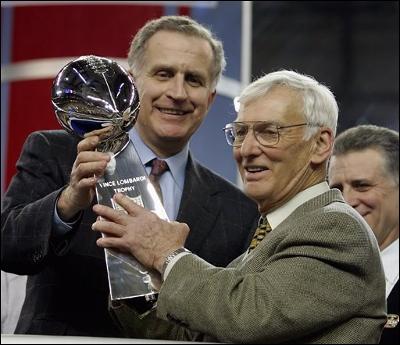
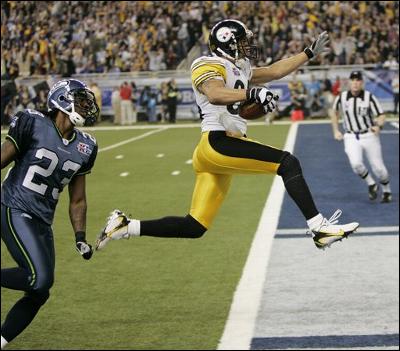
In a game that was more historic than well played, the Pittsburgh Steelers completed what may be the greatest stretch run in NFL history by defeating the Seattle Seahawks 21-10 in Super Bowl XL, capturing the 5th Super Bowl championship in franchise history. The Steelers' victory also provided a storybook ending to the Hall of Fame career of Jerome Bettis, who in his final game won the Super Bowl in his home town of Detroit. This Super Bowl had quite a few firsts and records, including the following:
1. Pittsburgh coach Bill Cowher won his first Super Bowl, silencing critics who said he couldn't win the big game.
2. The Steelers became the first No. 6 seed to win a Super Bowl, as well as the first Super Bowl champion to win 3 road playoff games en route to the Super Bowl.
3. The Steelers' Ben Roethlisberger became the youngest quarterback ever to win a Super Bowl.
4. Pittsburgh running back Willie Parker had the longest run in Super Bowl history with his 75-yard touchdown, breaking Marcus Allen's 22-year-old record.
5. Seattle defensive back Kelly Herndon recorded the longest interception return in Super Bowl history, breaking Willie Brown's 29-year-old record.


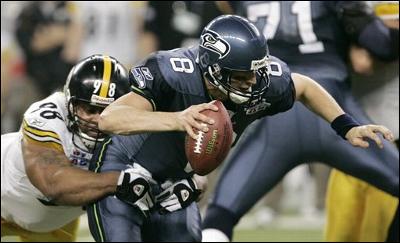
While this game was exciting in the sense that the outcome was uncertain until the final 5 minutes, the fact is that Super Bowl XL ranks right up there (or down there) with Super Bowl V as one of the worst played Super Bowls by both teams. Seattle receivers dropped a number of passes, the Seahawks had quite a few big plays called back because of penalties, and they were plagued by uncharacteristically poor execution and clock management at the end of both halves. And although they won the game, the Steelers played one of their worst games of the season. For much of the game (especially in the first half) they had problems covering Seattle receivers, and their offense didn't seem to have any rhythm until the second half. The Pittsburgh defense didn't get in many of the big, intimidating hits that define them. Both quarterbacks threw key interceptions in scoring range, and 2 of these interceptions (one by each team) changed the momentum of the game. And there were some key calls by the officials---the pass interference penalty that nullified a Seattle touchdown, the Roethlisberger touchdown, and the reversal of the Hasselbeck fumble---that may have played a role in shaping the outcome of the game (fortunately, the officials made the right call on all 3 plays).


If there was one thing that made the difference in this game, it was the big play. The Seahawks didn't make a lot of big plays (and it seemed that most of the ones they did make were nullified by penalties), while all 3 Pittsburgh touchdowns were the result of big plays (Roethlisberger's 37-yard pass to Hines Ward on 3rd & 28, Parker's 75-yard TD run, and Antwaan Randle El's 43-yard TD pass to Ward). Ward's big plays (5 receptions for 123 yards and 1 TD, 1 run for 18 yards) earned him the game's Most Valuable Player award.


Despite their problems defending against the pass and the scarcity of big hits, the Pittsburgh defense played pretty well. The Steelers held league MVP and leading rusher Shaun Alexander, who set the NFL record for touchdowns in a season with 28, to 95 yards on the ground and no touchdowns. The Steelers also limited the NFL's top scoring team to only 10 points. And despite not getting the type of pressure on the quarterback that they had against Indianapolis and Denver, the Steelers still sacked Hasselbeck 3 times.


In the end, however, it doesn't matter whether or not it was a pretty game. All that matters is that THE PITTSBURGH STEELERS ARE SUPER BOWL CHAMPIONS!!!!!

Saturday, February 04, 2006

Greenwood Gets the Shaft Again


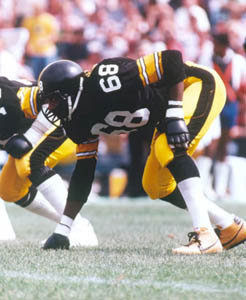
For the 20th straight year, Pittsburgh Steelers great L.C. Greenwood got the shaft from the voters for the Pro Football Hall of Fame. This was the 2nd straight year and the 6th overall that Greenwood was a finalist for the Hall of Fame. How Greenwood, one of the greatest defensive linemen of all time and a key member of the greatest defense and team of all time, can still not be in the Hall of Fame 25 years after his retirement is difficult to comprehend. Greenwood's career performance is definitely worthy of the Hall of Fame. During his brilliant career he was voted to the Pro Bowl 6 times, played on 4 Super Bowl championship teams, recorded 73.5 quarterback sacks (unofficially---the NFL didn't list sacks as an official statistical category until 1982), and recovered 14 fumbles. And like many of his Steeler teammates, Greenwood elevated his game to another level in the Super Bowl. His 3 batted passes and constant harassment of Minnesota QB Fran Tarkenton in Super Bowl IX helped set the stage for the Steelers' first championship. The following year, against Dallas in Super Bowl X, he sacked Cowboys' QB Roger Staubach 3 times. In 1991, Greenwood was voted to the Super Bowl Silver Anniversary Team.

A comparison of Greenwood's career with the careers of other defensive linemen voted to the Hall of Fame demonstrates his worthiness for enshrinement in Canton. Willie Davis (Green Bay, 1960-69) played in 5 Pro Bowls; Carl Eller (Minnesota, 1964-78) played in 6 Pro Bowls; Dan Hampton (Chicago, 1979-90) played in 4 Pro Bowls and recorded 57 sacks; and Lee Roy Selmon (Tampa Bay, 1976-84) played in 6 Pro Bowls, recorded 78.5 sacks, and recovered 10 fumbles. Greenwood's individual numbers measure up to these players', and of this group only Davis joins Greenwood as a member of multiple championship teams.

What surprised me the most about this year's election is that Dallas offensive tackle Rayfield Wright was chosen instead of Greenwood. Both men were chosen for 6 Pro Bowls, but Greenwood won 4 Super Bowls compared to Wright's 2. Wright's bio on the Hall of Fame web site gives a glowing account of Wright's performance in the 1975 playoffs, including Super Bowl X against the Steelers. The web site described Wright's play against Greenwood and Hall of Fame defensive ends Jack Youngblood and Carl Eller as "exceptional." I don't know how Youngblood and Eller did against Wright, but Greenwood recorded 3 of the Steelers' 7 sacks of Dallas QB Roger Staubach. That is hardly what I would call "exceptional play" by an offensive tackle. I'm not saying that Wright did not deserve to be elected to the Hall of Fame. He certainly is deserving of the honor, but he should NOT have been elected before L.C. Greenwood.

Monday, January 30, 2006

WOW!!!

Avalon's latest album Stand came out Tuesday! I got my copy yesterday, and this is an awesome CD!!! I've already listened to it about seven times. There was a four month delay from the original release date, but it was definitely worth the wait. There is not a single weak song on the entire CD. This album has it all, from up tempo songs like "The Other Side" and "Love Won't Leave You," to the beauty of "Where Joy and Sorrow Meet," to powerful anthems like "Orphans of God" and "Jesus" and "We Will Stand" (featuring Russ Taff, who made this song a classic in the early 1980s). If I had to pick a favorite song from the album it would probably be either "Jesus" or "Where Joy and Sorrow Meet," but they're all really good songs, and the vocals are impeccable. The unique, dynamic Avalon sound stands out on each song. After ten years and a few lineup changes, Avalon is still the best, and this is their best album yet!